
Appearance
Construction planes
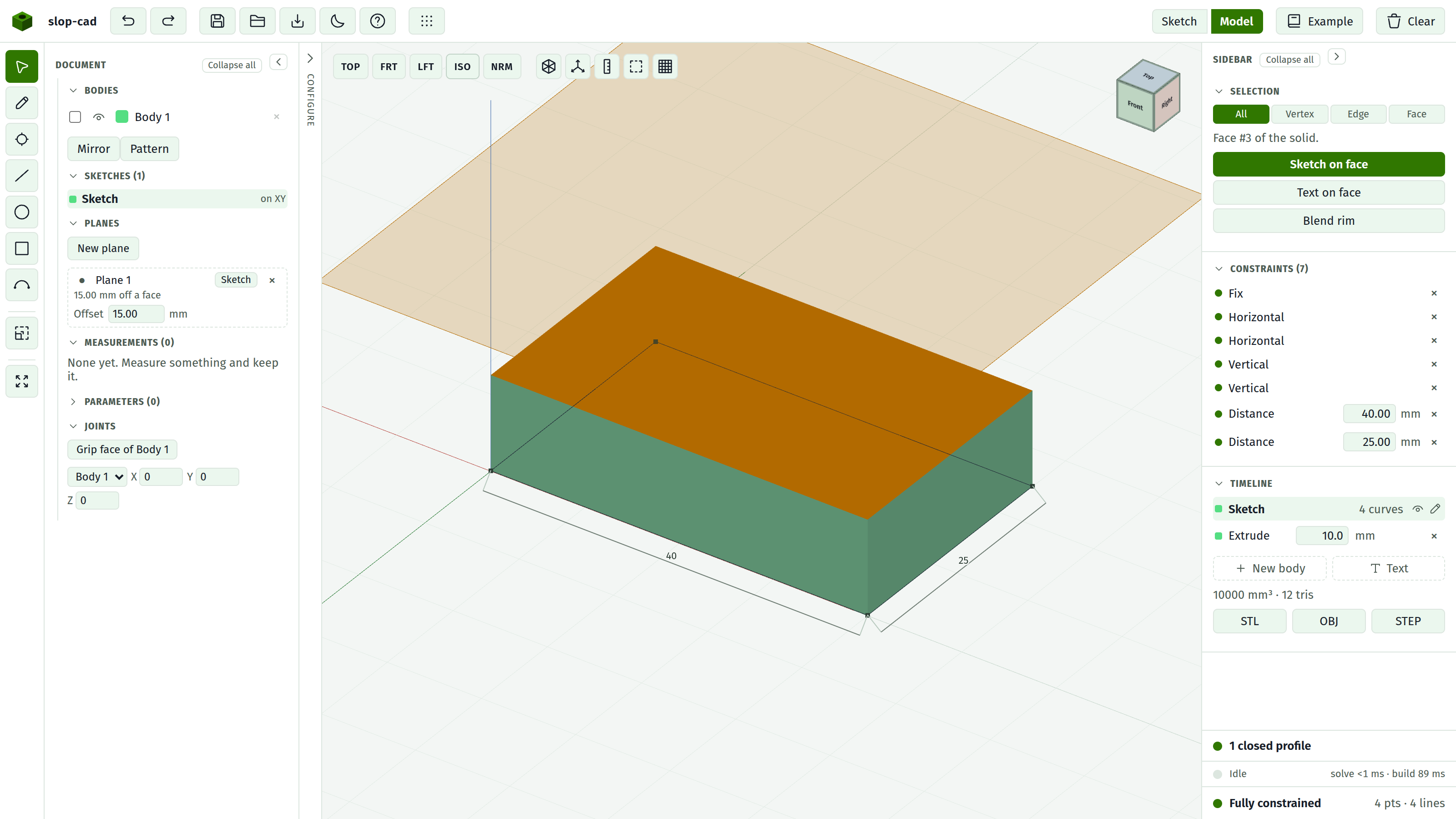
A construction plane is somewhere to draw that is not on the part. It carries no material, appears in no boolean, and adds nothing to a volume. It exists so a sketch can stand in mid-air above the solid, or on the symmetry plane through the middle of it.
Everywhere else a sketch has to sit on something: the world plane, or a flat face. A construction plane is the third answer, and the one that covers what neither can.
Making one
Press W, or New plane in the Planes group of the document panel. The dialog opens over the model view, and the solid stays clickable under it.
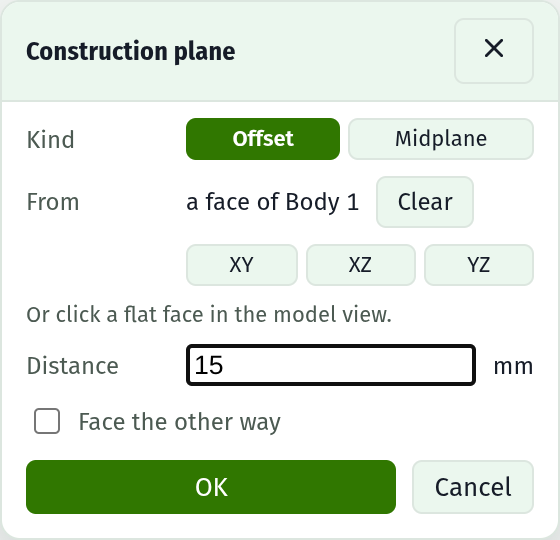
| Field | Notes |
|---|---|
| Kind | Offset stands a typed distance off one thing. Midplane stands halfway between two |
| From / First | What it is measured from: click a flat face in the model view, or press XY, XZ or YZ for a world plane |
| Second | The other side of a midplane. Picked the same way |
| Distance | Offset only. Millimetres, accepting arithmetic and parameter names. Positive goes the way the face points; negative goes the other way |
| Face the other way | Turns the plane over. Which side a derived plane faces follows from the face it came off, and that is not always the side you want to draw on |
| OK | Refused until there is something to measure from |
The two planes
Offset is the standing answer to "sketch above the part". Its origin is the face's own origin moved along the normal, so the coordinates on it are the coordinates on the face: a circle at 0,0 lands in the same place either way, just higher.
Midplane is the symmetry plane of a part. Between the two ends of a box it is the plane you mirror the case half in; between a face and the world plane the part sits on it is the mid-height plane. It faces the way the first thing picked faces, and its origin is the first face's origin moved half the gap, so the coordinates line up with that face too.
Two things that are not parallel have no plane halfway between them, and the dialog says so rather than guessing at a bisector.
Sketching on one
Press Sketch on the plane's row. A new sketch appears in the Timeline, labelled by the plane it sits on: Sketch on Plane 1.
From there it is an ordinary sketch. Draw a closed profile, extrude it, cut with it. The plane's own direction is which way the sweep runs, so Face the other way at plane time is the same as a negative distance at extrude time, and easier to read.
The list
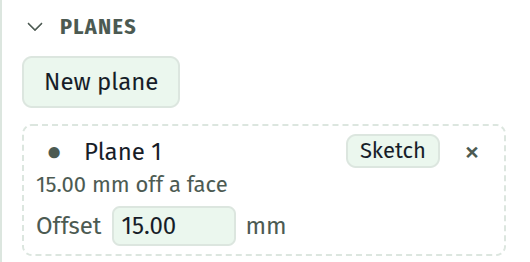
| Control | What it does |
|---|---|
| Name | Click to rename. Blank goes back to Plane N |
| ● / ○ | Show or hide the plane in the model view. Presentation only; nothing about the document changes |
| Sketch | Start a sketch on it |
| Offset | The distance, for an offset plane. Driveable from a parameter |
| × | Delete it, and every sketch drawn on it |
Deleting takes the sketches with it because they have nowhere else to stand. A sketch on a plane hangs off no face; without the plane there is nothing to derive its frame from, and leaving it behind would leave it drawing on a frame nothing can move.
It rides the part
A plane is a recipe, not a position. What the document holds is which face it is measured from and how far off, and the frame is worked out again on every rebuild.
Make the plate thicker and its top face rises. A plane 15 mm above that face rises with it, and so does everything sketched on the plane. Nothing in either sketch has to be touched, and no dimension changes.
The same holds for the offset itself: drive it from a parameter and the whole stack follows one row of the table.
When it stops deriving
A plane whose face is gone keeps the last frame it had and says so on its row, the same bargain a sketch on a vanished face gets. The document still builds; the row tells you what went.
| Message | What happened |
|---|---|
| the face it is measured from is gone | The feature that swept it changed, or was deleted |
| the face it is measured from is no longer flat | An edit turned it into something curved |
| the feature it is measured from has no solid | That feature is not building, so it has no faces at all |
| the two faces it stands between are not parallel | A midplane between two things that meet at an angle |
What is deliberately absent
- A plane through three points, or at an angle to a face. Offset and midplane are what the parts here have needed. An angled datum is a bigger question about how a rotation is named durably.
- A plane measured off another plane. An anchor is a face or a world plane, so planes do not chain.
- Planes in the timeline. A plane builds nothing, so there is nothing for the rollback marker to stand in front of. They live in their own section instead.
See also
- Sketch on a face, for the other way a sketch leaves the world plane
- Mirror, which a midplane is usually made for
- Face references, for what "the face it is measured from" is holding on to